The SAS Lab Sustainable & Advanced Systems Laboratory
Green and Sustainable Approaches for Critical Metal Recovery and Energy Storage Systems. Bridging fundamental inorganic coordination chemistry with scalable circular economy solutions.
Three Core Research Pillars
Applying fundamental principles of inorganic, coordination, and physical chemistry to address global clean energy and resource sustainability challenges.
Critical Mineral Recovery
Electro- and coordination chemistry for extracting rare earth elements (REEs) from domestic ores and selective recycling of transition metals from spent lithium-ion batteries (LIBs).
Waste Valorization
Transforming low-cost industrial byproducts, like surplus elemental sulfur, into high-value functional materials and dynamic polymer scavengers for toxic and critical metal recovery.
Clean Hydrogen Initiatives
Engineering advanced materials and electrochemical hydrogen pump (EHP) devices for sustainable hydrogen purification, reformate cleanup, and geological hydrogen harvesting.
Our Research Team
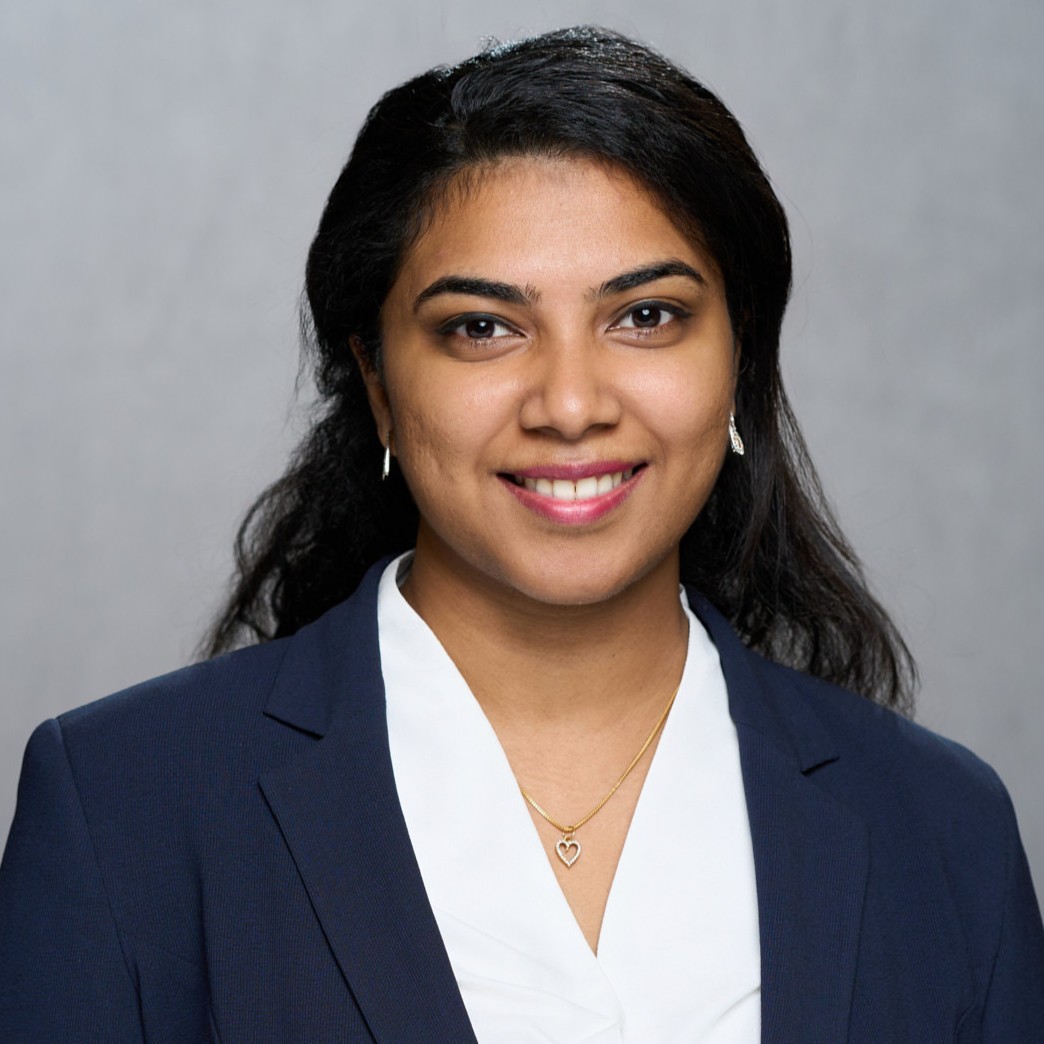
Dr. Suchithra Ashoka Sahadevan, Ph.D.
Assistant Professor & Principal Investigator (The SAS Lab)
Department of Chemistry, Indian Institute of Technology Madras (IIT Madras)
Research Highlights & Leadership Overview
Dr. Suchithra Ashoka Sahadevan leads the Sustainable & Advanced Systems Laboratory (SAS Lab) at IIT Madras. Her scientific career spans renowned international institutions across the United States, Sweden, France, and Italy. With over 45 peer-reviewed publications, 770+ citations (h-index 13), and co-inventorship on patented circular battery recycling technologies, her research bridges fundamental coordination chemistry with scalable sustainability.
Prior to joining IIT Madras, she served as a Senior Scientist and Postdoctoral Research Associate at Washington University in St. Louis (USA) under Prof. Vijay Ramani, where she co-led US Department of Energy (DOE) programs on electrochemical hydrogen purification and battery recycling. She was also a Postdoctoral Fellow at KTH Royal Institute of Technology (Sweden) in applied physical chemistry, and completed a joint international Ph.D. from Université d'Angers (France) and the University of Cagliari (Italy), graduating with highest honors (cum laude).
Education
- • Ph.D. in Chemical Sciences & Technologies (Inorganic Chemistry) — Université d'Angers (France) & Univ. of Cagliari (Italy). Best PhD Award, cum laude.
- • BS-MS Dual Degree — Indian Institute of Science Education & Research (IISER Kolkata), India. (DST-INSPIRE Scholar).
Selected Honors & Grants
- • KTH Postdoctoral Scholarship, Sweden (2021)
- • Best PhD Award (cum laude), Univ. of Cagliari (2019)
- • CCDC Crystallographic Award, AIC Naples, Italy (2019)
- • National Winner, Bando Cassini Call, French Embassy (2018)
- • DST INSPIRE Scholarship, Govt. of India (2010–2015)
Key Scientific Domains
The SAS Lab: Sustainable & Advanced Systems Laboratory
Green and Sustainable Approaches for Critical Metal Recovery and Energy Storage Systems
The transition toward a circular economy and clean energy infrastructure requires innovative resource recovery and energy conversion solutions. To meet these macroscopic sustainability challenges, the SAS Lab applies fundamental principles of inorganic and physical chemistry. Our research focuses on developing environmentally benign processes for the extraction and recycling of critical minerals, specifically rare earth elements (REEs) from domestic ores and transition metals from spent lithium-ion batteries (LIBs), using coordination chemistry and electrochemical methods. Additionally, we focus on waste valorization by synthesizing value-added materials from industrial waste, such as surplus elemental sulfur, and engineering materials for the clean hydrogen mission, including electrochemical hydrogen purification devices. By addressing these systems at both fundamental and applied levels, our lab bridges the gap between scalable sustainability and fundamental chemical sciences.
Three Core Pillars
Critical Mineral Recovery
Electro- and coordination chemistry for extracting REEs and recycling transition metals from spent LIBs.
Waste Valorization
Transforming industrial byproducts, like surplus elemental sulfur, into high-value functional materials.
Clean Hydrogen Initiatives
Engineering materials and electrochemical devices for sustainable hydrogen purification.
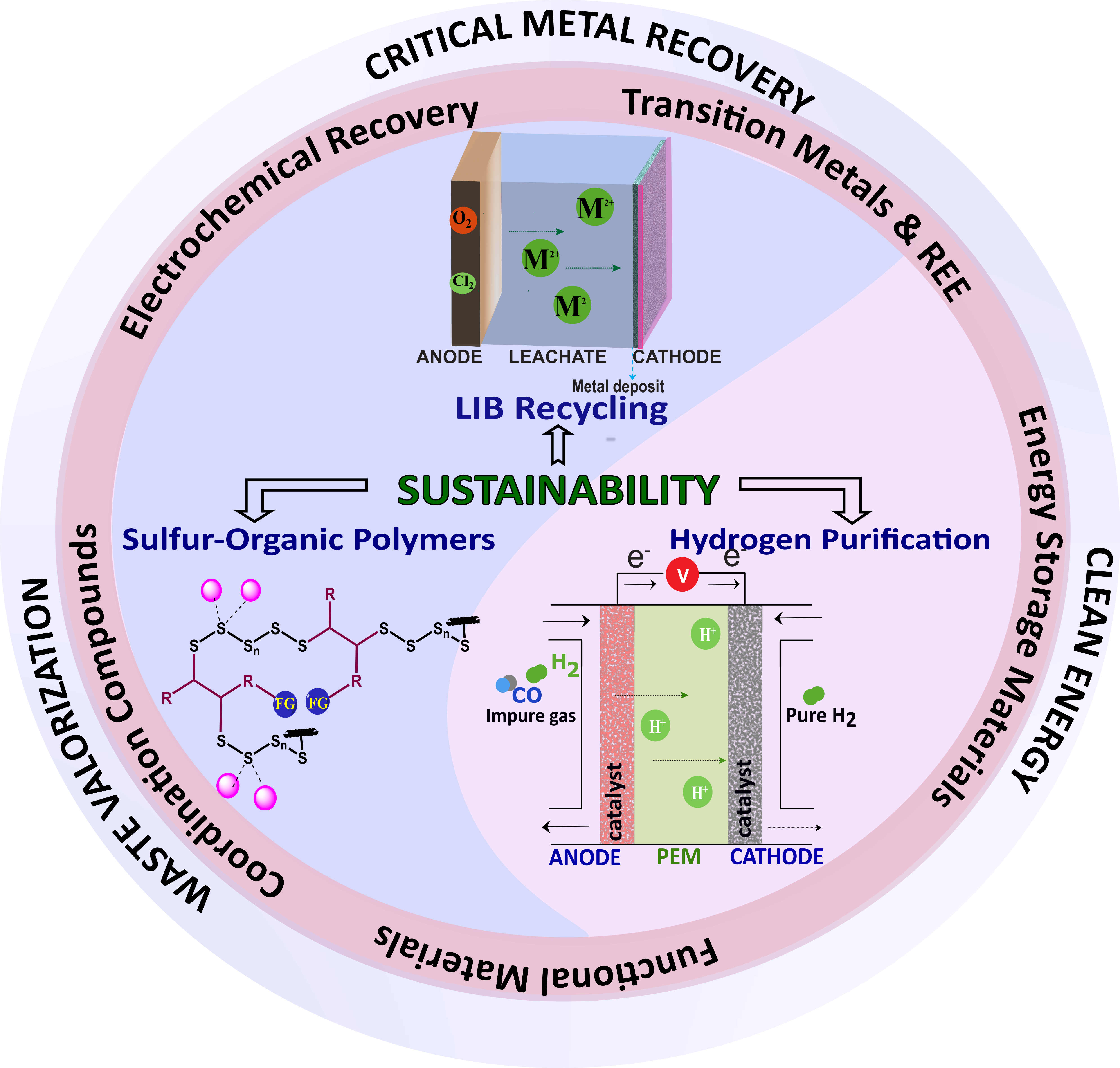
Integrated Circular System Overview
Detailed chemical mapping of critical metal recycling, sulfur valorization, and clean hydrogen infrastructure.
Green Solvometallurgy with High-Voltage DES
Traditional battery recycling relies on energy-intensive pyrometallurgy and corrosive aqueous acids with narrow stability windows (~1.23 V). We design ternary deep eutectic solvents (DESs) with electrochemical stability windows > 4.0 V vs Ag. This allows direct, high-purity electrodeposition of electronegative metals without multi-stage solvent extraction.
Sulfur Polymers & Electrochemical Hydrogen Pumps
Synthesizing sulfur-oleylamine dynamic copolymers via inverse vulcanization for the selective uptake of copper from battery waste. In clean hydrogen systems, we engineer pulsed-oxidation CO-tolerant electrocatalysts and reinforced ionomer membranes for high-temperature electrochemical hydrogen pumps (EHPs).
Publications & Patents
Synced from Google Scholar: Ashoka Sahadevan Suchithra
Laboratory News & Updates
Keep up with our latest research findings, journal covers, grant accomplishments, and recruitment calls.
Establishment of The SAS Lab at IIT Madras
Dr. Suchithra Ashoka Sahadevan has joined the Department of Chemistry at the Indian Institute of Technology Madras (IIT Madras) as an Assistant Professor, establishing the Sustainable & Advanced Systems Laboratory (SAS Lab) dedicated to critical metal recovery and sustainable energy storage.
Call for Applications: PhD Scholars and Project Staff
The SAS Lab is actively accepting applications for Ph.D. scholars, Postdoctoral Fellows, and Undergraduate research interns. Candidates with a strong background in Inorganic Chemistry, Materials Science, Electrochemistry, or Chemical Engineering are strongly encouraged to apply.
View Application Details →Paper Published in ACS Sustainable Chemistry & Engineering
Our research on Pulsed Oxidation-Driven Catalyst Regeneration Enabling Durable CO-Tolerant Low-Temperature Electrochemical Hydrogen Pumps has been published in ACS Sustainable Chem. Eng. (2025, 13, 15875–15886).
Explore in Publications →Breakthrough in Battery Recycling Published in J. Mater. Chem. A
Our seminal article on Lithium-ion battery recycling: Ternary deep eutectic solvents for efficient electrochemical recovery of metals appears in Journal of Materials Chemistry A (2025, 13, 12625–12638).
Teaching & Mentorship
Inspiring the next generation of chemists and materials scientists through inquiry-based learning, rigorous fundamentals, and hands-on laboratory practice.
CY5022: Advanced Inorganic & Sustainable Materials Chemistry
This advanced postgraduate/undergraduate elective course covers the fundamental principles of coordination chemistry, solid-state materials, and solvometallurgical systems for sustainable energy applications. Topics include metal-organic frameworks (MOFs), deep eutectic solvents (DES), electrochemical characterization, and battery material recycling.
Pedagogical Philosophy
Our teaching approach blends conceptual rigor with real-world technological challenges. Students are encouraged to connect fundamental molecular and electronic structures (e.g., ligand-field theory, redox potentials, molecular orbital interactions) to global sustainability challenges in energy storage and resource conservation.
- ✓ Interactive problem-solving & flipped classroom discussions
- ✓ Literature critique of landmark and contemporary high-impact papers
- ✓ Hands-on electrochemical experimentation and data interpretation
Prior Teaching Experience
Contact Us & Laboratory Openings
We are situated in the Department of Chemistry at the lush, scenic IIT Madras campus in Chennai, India.
Lab Address & Coordinates
Send a Quick Message
Direct message to Dr. Suchithra's official inbox.
IIT Madras Campus & Research Facilities
Chennai, India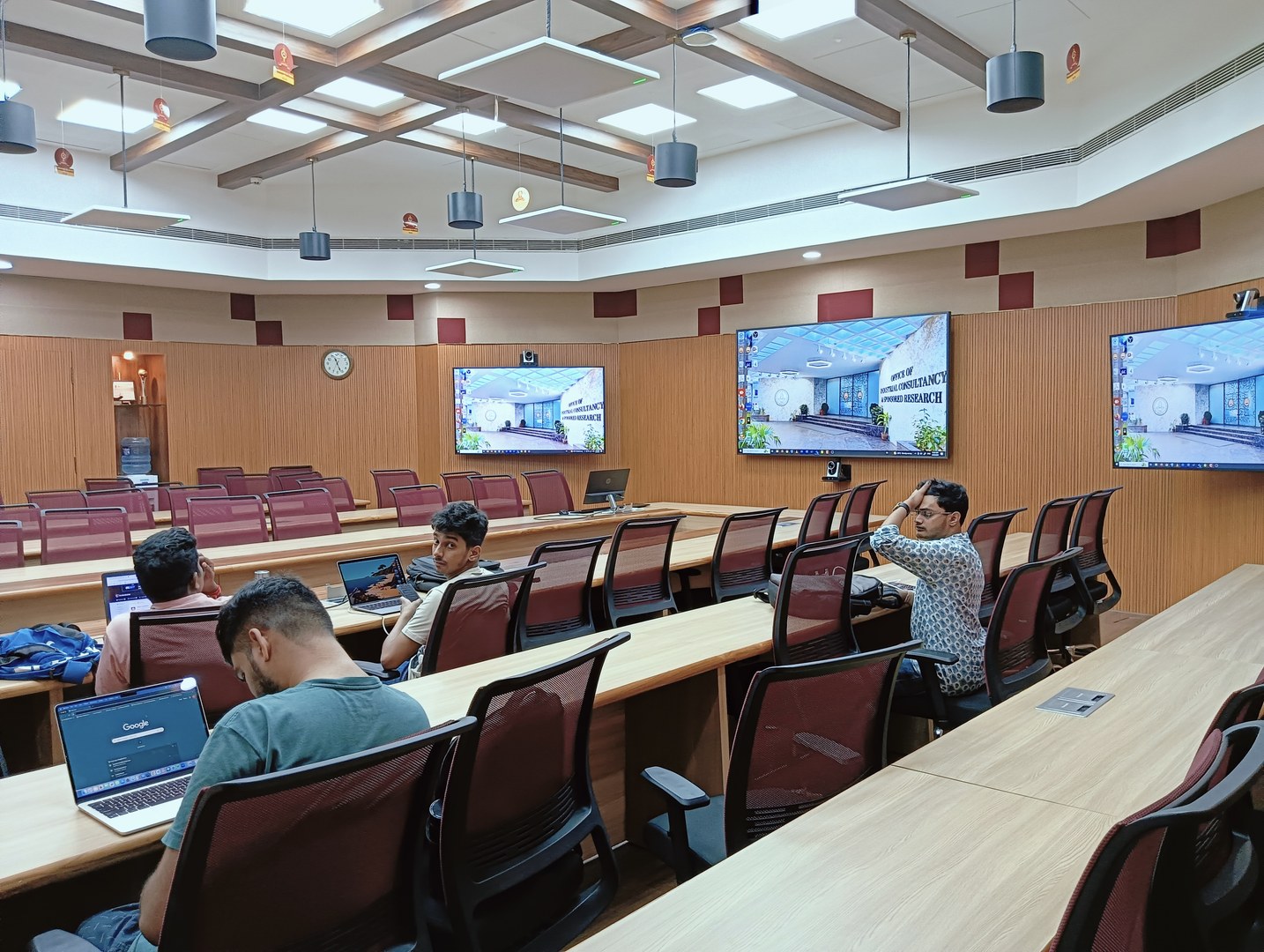
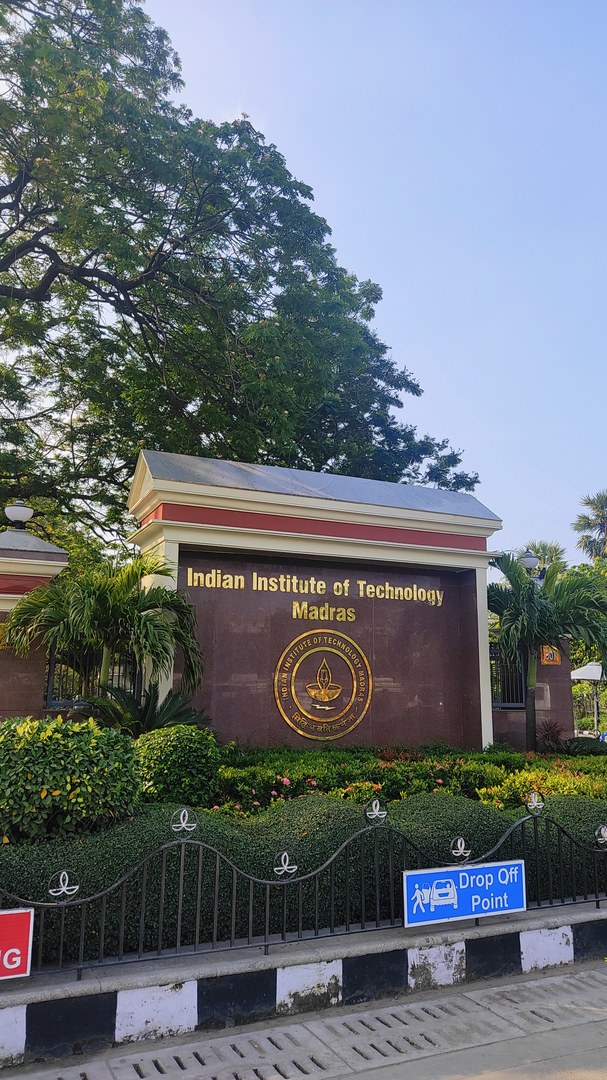
Spanning 600+ acres of scenic national park reserve, IIT Madras offers world-class analytical and characterization facilities, including advanced XRD, high-resolution TEM/SEM, multinuclear NMR, XPS, and specialized electrochemical workstations.